
About the Constitution
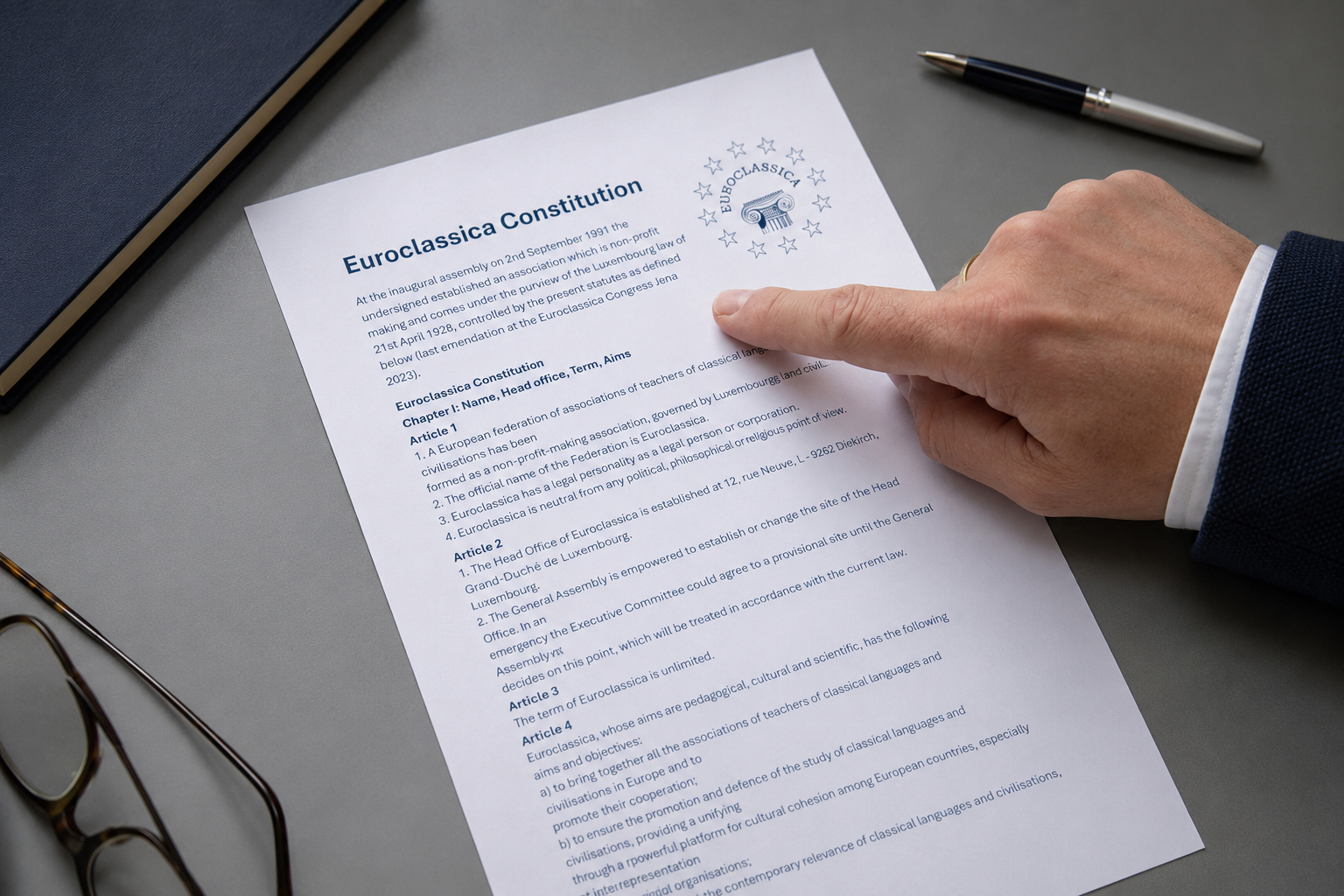
Founded at its inaugural assembly on 2 September 1991, EUROCLASSICA is a non-profit association established under Luxembourg law and governed by its statutes, most recently amended at the EUROCLASSICA Congress in Jena in 2023.
Independent and self-supporting, EUROCLASSICA brings together member associations from across Europe – from Sweden to Malta and from Portugal to Cyprus. Through a shared commitment to cooperation, annual conferences, and mutual support, the association provides a stable framework for its initiatives and activities.
Below you can download the current version of the Constitution in different language versions.
Download the Constitution
Current version, available in two languages.
Article 1
- A European federation of associations of teachers of classical languages and civilisations has been formed as a non-profit-making association, governed by Luxembourg law.
- The official name of the Federation is EUROCLASSICA.
- EUROCLASSICA has a legal personality as a legal person or corporation.
- EUROCLASSICA is neutral from any political, philosophical or religious point of view.
Article 2
- The Head Office of EUROCLASSICA is established at 12, rue Neuve, L-9262 Diekirch, Grand-Duché de Luxembourg.
- The General Assembly is empowered to establish or change the site of the Head Office. In an emergency the Executive Committee could agree to a provisional site until the General Assembly decides on this point, which will be treated in accordance with the current law.
Article 3
The term of EUROCLASSICA is unlimited.Article 4
EUROCLASSICA, whose aims are pedagogical, cultural and scientific, has the following aims and objectives:- to bring together all the associations of teachers of classical languages and civilisations in Europe and to promote their cooperation;
- to ensure the promotion and defence of the study of classical languages and civilisations, providing a unifying link and a powerful platform for cultural cohesion among European countries, especially through representation at international organisations;
- to assert publicly the contemporary relevance of classical languages and civilisations, and to highlight the pressing need to teach them, fully respecting the autonomy of each country;
- to encourage cooperation with associations outside Europe which have similar aims.
Article 5
The minimum number of member associations of EUROCLASSICA is that established by Luxembourg law.Article 6
- The following may become members of EUROCLASSICA:
- national associations of teachers of classical languages and civilisation, which have been legally constituted in European states.
- regional, provincial or local associations of Classical culture to which teachers of classical languages and civilisation are affiliated in states where associations mentioned under a) do not exist. Such may also include Classics departments of universities, which bring together alumni/teachers, when a national teachers\\\\\\\\\\\\\\\' organization is missing, until a new association is founded.
- The name and the nationality of member associations are indicated in a list annexed to this constitution. It shall be revised annually.
- The General Assembly may also appoint Associate Partners for cases that do not fall under heading 6, 1. The Associate Partners are listed on the EUROCLASSICA website. They are not entitled to pay the annual subscription and have no right to vote in the General Assembly. Associate Partners are encouraged to take part in all EUROCLASSICA activities. There is no restriction on the maximum number of Associated Partners, and there may be several from the same country. The main aim of the collaboration between EUROCLASSICA and the Associate Partners is to ensure mutual support. The annulment of the Associated Partnership can be done by written request of one of the parties.
Article 7
All member associations shall pursue the aims of the Federation and take part in its activities.Article 8
The statutes and rules of procedure as well as the resolutions of the General Assembly and the Executive Committee shall be respected by all member associations.Article 9
Requests for admission to membership from new associations must be sent to the Executive Committee, which will examine any such request and submit it to the next General Assembly. The General Assembly will then examine such request and decide on the admission by a simple majority of member associations present or represented.Article 10
The member associations must pay an annual subscription, the amount of which is fixed by the General Assembly. Members have the right to vote under the conditions determined in article 14.Article 11
Member associations will be presumed to have left the Federation upon receipt by the Executive Committee of a letter of resignation from such member.Article 12
- The Executive Committee must propose to the General Assembly the exclusion of member associations of EUROCLASSICA which:
- have seriously departed from the aims of the Federation;
- do not pay their annual subscription after two reminders from the Treasurer in respect of the same year.
- The exclusion of members of the Federation can be pronounced by the General Assembly only after the association whose exclusion is proposed has been invited to present its defence. A majority of two-thirds of the members present or represented is required to determine the exclusion. The ballot must be in secret. The decision is final and there is no appeal.
- Member associations who leave the Federation (by resignation or by exclusion) have no claim on its assets and may not claim any reimbursement of payments already made.
Article 13
Member associations have the right to vote under the conditions determined in article 14.First Section: General Assembly
Article 14
- The General Assembly is composed of representatives of the member associations. All member associations of the General Assembly are to be officially invited to the meetings within the stated time limit.
- Each member association is entitled to be represented by one delegate within the Federation.
- Member associations which are not up to date with their subscription payments in the calendar year preceding that of the General Assembly will have their right to vote at the General Assembly suspended until they have paid their dues.
- Subject to a written authorisation, each member association unable to attend the General Assembly may grant a proxy vote to the delegate of another association of the Federation. This authorisation must be handed to the President at the beginning of the meeting.
- Also officially invited to the General Assembly are the directors of activities or programmes organised in the name of EUROCLASSICA.
- National member associations have one vote in the General Assembly. If several associations represent the same country with several official languages and different education systems, they will each have one vote.
Article 15
- The General Assembly is the supreme body for the attainment of the aims of the Federation.
- The following tasks are the specific competence of the General Assembly:
- approval of the accounts for the past year and of the budget for the coming year;
- election and dismissal of Executive Committee members;
- changes to the constitution;
- exclusion of members;
- dissolution of the Federation;
- determining the annual rate of subscription;
- all the tasks attributed to it under the present constitution.
Article 16
The General Assembly must meet in normal session once every year, at the venue indicated on the notification. Notification is made on the initiative of the President and issued by the Secretary.Article 17
- The notification must be sent at least six weeks before the date of the General Assembly. It must contain the agenda and, if necessary, the list of candidates for Executive Committee posts.
- Any member, individually or together with others, may request the inclusion of an item on the agenda by written request addressed to the President, by the beginning of the meeting at the latest. In this case the President will put the inclusion of the requested point on the agenda to a majority vote of the General Assembly.
- Any proposal signed by a number of members equal to one twentieth of the last annual list of member associations must be included on the agenda.
Article 18
- In agreement with the Executive Committee the President may call an extraordinary meeting of the General Assembly.
- Such a meeting must be called when one fifth of the member associations make a written request, giving reasons for the meeting, to the Executive Committee within the time limits mentioned above.
Article 19
- Decisions of the General Assembly will be deemed to be valid if half the member associations plus one are present or represented in the meeting.
- The Assembly considers and votes on only those items listed on the agenda.
- Except in cases foreseen by the present statutes, all decisions are taken by means of a simple majority vote of the members present or represented who exercise their vote.
- It is the task of the General Assembly to approve the regulations and make decisions as may be required to interpret and apply these articles and to achieve the goals of EUROCLASSICA.
- The text of the decisions of the General Assembly will be incorporated in the minutes of each meeting signed by the President and the Secretary. It will be sent to each member association.
Second Section: Executive Committee
Article 20
- The day to day administration of the Federation will be carried out by an Executive Committee consisting of at least 4 members elected by the General Assembly: President, Vice-President, Secretary, Treasurer and Officer in charge of banking (who must be of Luxembourg nationality but can be possibly supported or relayed by the President) and at most two others.
- The members of the Executive Committee shall be elected under the following conditions:
- no member association may have more than one member on the Executive Committee;
- each member shall be elected for a period of four years;
- the mandate of the President is for four years and shall not last more than eight consecutive years;
- no member of the Executive Committee may sit on the Committee for more than eight consecutive years, except the Luxembourg member;
- the Executive Committee has the power to co-opt a temporary member in the case of an unexpected vacancy until the following General Assembly, with the exception of that of the President.
Article 21
- The Executive Committee will meet at least once each year upon notification by the President.
- The Executive Committee forms a quorum when at least three of its members are present including the President and the Secretary.
Article 22
- The Executive Committee has all powers to manage and administer the Federation.
- It may delegate the exercise of certain responsibilities.
- It is accountable to the General Assembly for all its actions.
Article 23
- Resolutions of the Executive Committee are taken by a majority of the votes of its members present. In the event of parity the President has the casting vote.
- The decisions are to be entered into the minutes of the meeting signed by the President and the Secretary. The minutes will be sent to all member associations of the Federation.
Article 24
Legal action is taken by the Executive Committee represented by its President or by a member of the Executive Committee appointed by the President for this purpose.Third Section: President
Article 25
- The President of EUROCLASSICA presides over the Federation, the General Assembly, and the Executive Committee.
- The President represents the Federation in law. The President is elected for a term of four years.
- In the case of a major impediment to the President, the Vice-President will assume the presidency until the President\\\\\\\\\\\\\\\'s return, or in the case of death or resignation, until the election of a new President by the General Assembly.
Article 26
The financial term begins on 1st January of each year and ends on 31st December of the same year.Article 27
- The Executive Committee is required to submit for the approval of the General Assembly the accounts for the past financial term and the budget for the following financial term.
- The General Assembly may decide to create a reserve fund and fix the amount and terms of the contribution to be paid to this fund by each member association.
Article 28
- Any proposition to modify the constitution may only be proposed by the Executive Committee or by at least a quarter of the members of the General Assembly.
- The Executive Committee must bring the proposal for modification to the attention of the members of the Federation at least three months in advance of the date of the General Assembly which will decide upon the said proposal.
- Any decision of the General Assembly to modify the statutes shall be deemed to be valid if at least two thirds of the members of the Federation with a right to vote are present or represented.
- No decision to modify the constitution may be reached unless it is approved by a majority of two thirds of the votes.
- If this General Assembly does not consist of two thirds of the members of the Federation, a new General Assembly will be convened under the same conditions as above, which will decide definitively and validly on the proposal in question, whatever the number of members present or represented.
Article 29
- The dissolution of the Federation can be declared only at a General Assembly called specifically for this purpose.
- The dissolution can be decided only if two thirds of the members are present. If this condition is not met, a second meeting will be called which will make a valid decision whatever the number of members present. The dissolution will be pronounced only if voted for by a majority of two thirds of the votes of the members present.
- In case of dissolution, the assets of the Federation will be realised and the balance allotted to an aim as close as possible to the aims of the liquidated Federation.
Article 30
- All matters not provided for in the present statutes will be determined in accordance with the provisions of Luxembourg law, as well as the decisions taken by the General Assembly and the Executive Committee within their respective competences.